
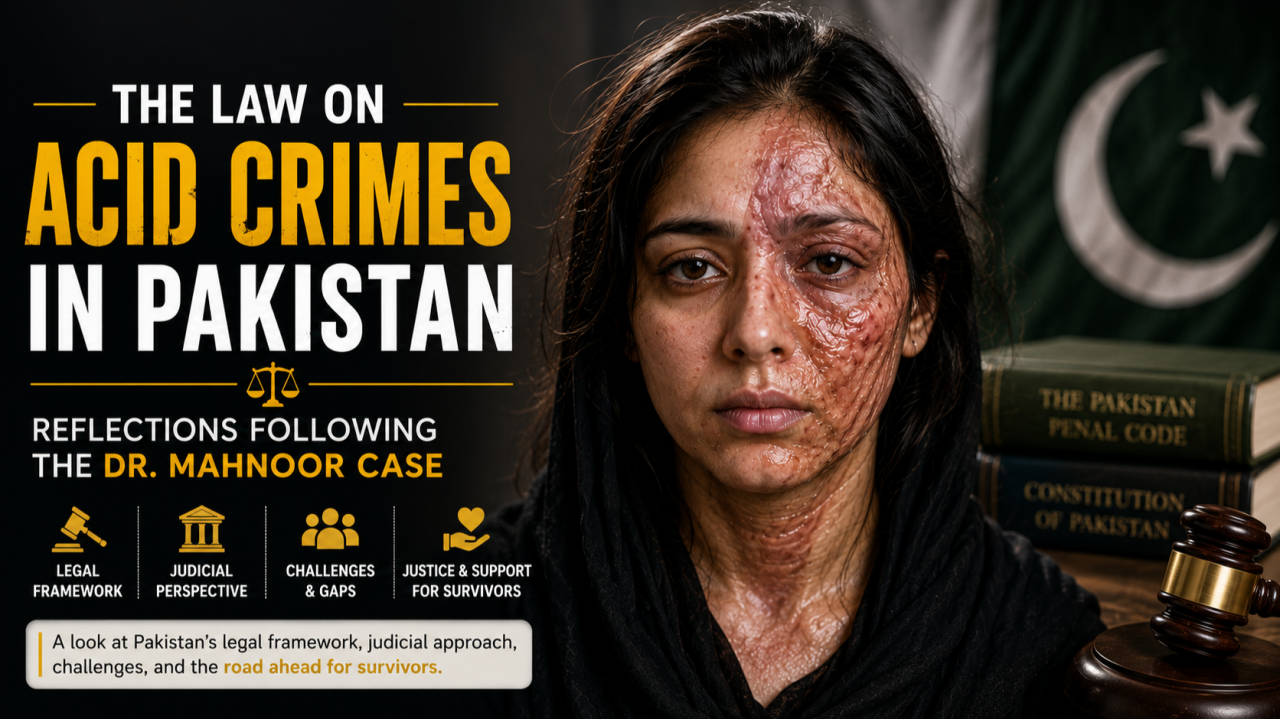
"The Law on Acid Crimes in Pakistan: Reflections Following the Dr. Mahnoor Case"
Using the recent Dr. Mahnoor case as a point of reflection, this article analyses Pakistan's legal framework on acid crimes, the role of the courts in addressing acid violence, and the challenges that remain in ensuring accountability, prevention, and meaningful support for survivors.
Introduction
The recent acid attack on Dr. Mahnoor has shocked many across Pakistan. Beyond the immediate horror of the incident, the case has once again drawn attention to a form of violence that leaves victims with far more than physical injuries. Acid attacks often result in lifelong disfigurement, psychological trauma, social isolation, and financial hardship. It is for this reason that acid violence is widely regarded as one of the most devastating forms of gender-based and personal violence.
As discussions surrounding the case continue, it is important to look beyond the facts of a single incident and examine the legal framework that exists to address acid violence in Pakistan. Over the past decade, Pakistan has taken significant steps to strengthen its laws against acid crimes. Today, acid attacks are treated as distinct criminal offences under the Pakistan Penal Code and carry penalties that may extend to life imprisonment. The real question, however, is whether legal reform alone is enough to protect victims and prevent such attacks from occurring.
1. Historical Background: The Evolution of Pakistan's Legal Response to Acid Crimes
For many years, acid attacks were prosecuted under general provisions relating to hurt and bodily injury. While these provisions criminalised violence, they did not fully recognise the unique and devastating nature of acid attacks. Victims were often left with permanent physical injuries, emotional trauma, and social consequences that extended far beyond what ordinary assault provisions contemplated.
Public awareness, advocacy by civil society organisations, and growing concern over acid violence eventually led to legal reform. In response, Parliament enacted the Acid Control and Acid Crime Prevention Act, 2011, introducing Sections 336-A and 336-B into the Pakistan Penal Code. The legislation marked a significant shift in Pakistan's approach by treating acid attacks as a distinct and particularly serious form of criminal conduct. The purpose of the reform was not only to increase punishment but also to send a clear message that acid violence would no longer be treated as an ordinary assault. Instead, it would be recognised as a crime capable of permanently altering a person's life.
2. The Current Legal Framework
A. Section 336-A of the Pakistan Penal Code
Section 336-A addresses hurt caused by corrosive substances, including acid. The provision recognises the unique harm caused when a person intentionally uses such substances to inflict injury. Unlike many other forms of violence, acid attacks often leave permanent scars, disfigurement, loss of bodily function, and irreversible damage. The law therefore acknowledges that the consequences extend far beyond the initial physical injury and can affect every aspect of a victim's life.
B. Section 336-B of the Pakistan Penal Code
Section 336-B provides the punishment for causing hurt through corrosive substances. The provision imposes severe penalties, including imprisonment that may extend to life imprisonment together with substantial fines. The objective is both punitive and deterrent. The law seeks not only to punish offenders but also to discourage others from engaging in similar conduct. The severity of the punishment reflects the seriousness with which the law views acid violence and the lasting impact such attacks have on victims.
C. Regulation of Acid and Corrosive Substances
An effective legal response requires more than punishment after an attack has occurred. Prevention is equally important. For this reason, legal and regulatory measures have sought to improve oversight regarding the sale and distribution of corrosive substances. The rationale is straightforward: if dangerous substances are more difficult to obtain without accountability, opportunities for misuse can be reduced. While regulation alone cannot eliminate acid violence, it remains an important component of any broader prevention strategy.
D. A Constitutional Perspective
Acid attacks engage some of the most fundamental rights protected by Pakistan's Constitution. Article 9 guarantees the right to life, while Article 14 protects the dignity of man. Acid violence strikes directly at both of these constitutional guarantees because it threatens not only physical safety but also the dignity, identity, and social existence of the victim.
The Supreme Court's decision in Shehla Zia v WAPDA (PLD 1994 SC 693) remains particularly relevant in this regard. In that case, the Court held that the right to life under Article 9 extends beyond mere animal existence and includes the right to live with dignity, safety, and a quality of life consistent with human worth. Although the case concerned environmental harm, its broader constitutional reasoning applies equally to acid attacks, which fundamentally undermine the values that Articles 9 and 14 seek to protect.
Viewed through this constitutional lens, acid violence is not simply a criminal offence against an individual. It is an attack on constitutional values that lie at the heart of a democratic society.
3. Has the Law Been Effective?
The Acid Control and Acid Crime Prevention Act, 2011 represented a major step forward in Pakistan's response to acid violence. By introducing specific offences and imposing severe punishments, the law acknowledged that acid attacks are fundamentally different from ordinary assaults because of the permanent physical, psychological, and social harm they inflict. The courts have generally supported this approach, treating acid attacks as particularly grave offences deserving strict punishment. In Muhammad Yaqoob v The State (Criminal Appeal No. 271 of 2019, Supreme Court of Pakistan), the Supreme Court demonstrated a clear unwillingness to treat acid attacks leniently, recognising the devastating and often irreversible consequences suffered by victims.
However, the effectiveness of any law cannot be measured solely by the severity of its penalties. While Pakistan's legal framework has undoubtedly strengthened accountability, incidents such as the alleged attack on Dr. Mahnoor remind us that legislation alone cannot eliminate acid violence. A law may punish offenders after an attack occurs, but it cannot by itself prevent the harm from taking place.
The more difficult challenge lies in implementation. Effective investigations, timely prosecutions, regulation of corrosive substances, and meaningful support for survivors are equally important. Critics argue that public discussion often focuses on punishment while paying less attention to rehabilitation, despite the fact that many survivors require years of medical treatment, psychological support, reconstructive surgery, and social reintegration. Pakistan's legal framework against acid crimes is significantly stronger today than it was a decade ago. Yet the true measure of its success lies not only in securing convictions but also in preventing attacks and ensuring that survivors are able to rebuild their lives with dignity.
4. Beyond Criminal Punishment: The Need for a Holistic Response
Acid violence cannot be addressed solely through imprisonment and fines. Survivors frequently require multiple surgeries, psychological counselling, rehabilitation services, and financial assistance. Recovery is often a long and difficult journey that extends well beyond the conclusion of a criminal trial.
A comprehensive response should therefore involve healthcare institutions, law enforcement agencies, policymakers, civil society organisations, and local communities working together. Greater regulation of acid sales, improved victim support services, public awareness campaigns, and accessible medical treatment all have a role to play. True justice requires more than punishing offenders. It requires ensuring that survivors receive the support necessary to reclaim their lives and participate fully in society once again.
Conclusion
The Dr. Mahnoor case has once again brought the issue of acid violence into the national conversation. While the details of the case will ultimately be determined through the legal process, the incident serves as a reminder that acid attacks remain one of the most devastating forms of violence in society.
Pakistan today possesses a far stronger legal framework against acid crimes than it did a decade ago. The introduction of specialised offences, stricter penalties, and greater judicial recognition of the seriousness of acid violence reflects an important commitment to protecting victims and holding perpetrators accountable.
Yet the challenge does not end with legislation. The real measure of success lies in effective enforcement, meaningful victim support, and a collective commitment to ensuring that no individual has to endure the lifelong consequences of acid violence. Cases such as that of Dr. Mahnoor remind us that the pursuit of justice is not only about punishment. It is also about protection, dignity, and the reaffirmation of every person's right to live free from fear and violence.