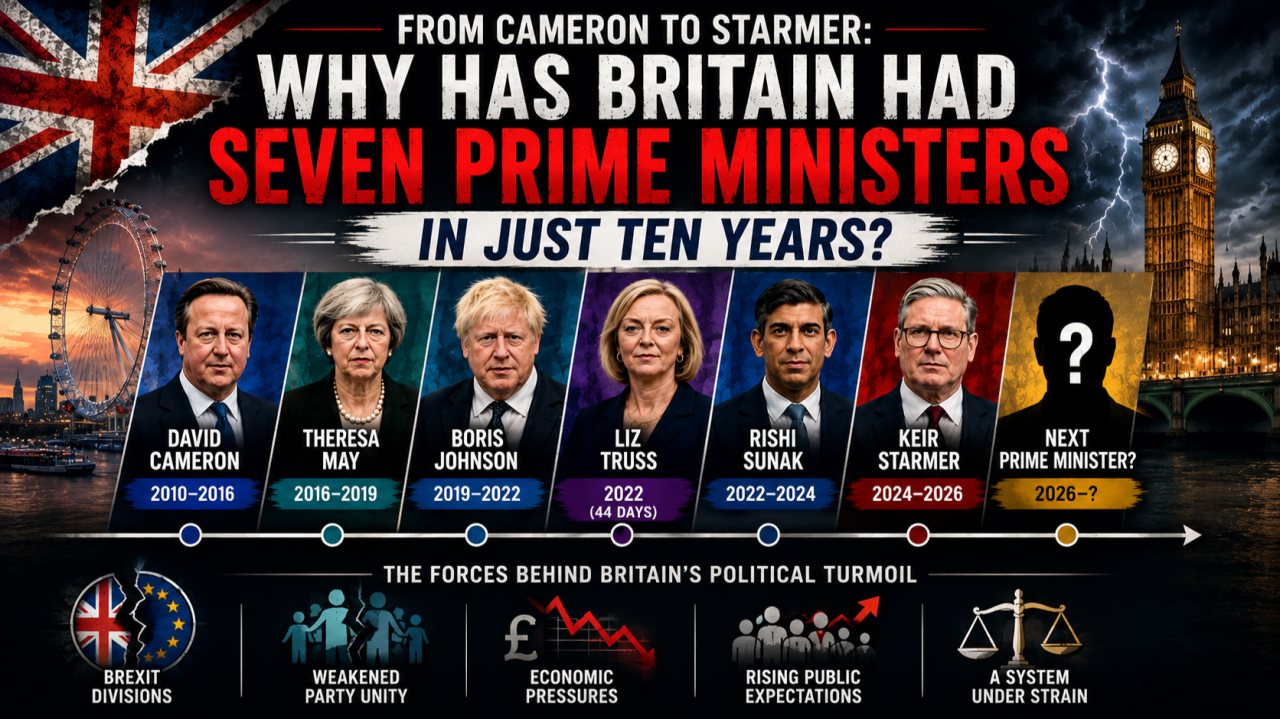
From Cameron to Starmer: Why Has Britain Had Seven Prime Ministers in Just Ten Years?
This article examines why Britain has witnessed seven Prime Ministers in just ten years, arguing that the rapid turnover reflects deeper structural challenges rather than a series of individual leadership failures.
Abstract
Britain has experienced an unprecedented period of political instability, with seven Prime Ministers serving in just ten years between 2016 and 2026. This rapid turnover has raised important constitutional and political questions about the resilience of the United Kingdom's system of parliamentary government. While each premiership ended for different immediate reasons including the Brexit referendum, parliamentary deadlock, political scandal, economic turmoil and electoral defeat - these episodes reflect deeper structural challenges rather than isolated leadership failures. This article argues that Brexit fundamentally disrupted Britain's political equilibrium by intensifying party divisions, weakening traditional conventions of leadership, increasing economic and constitutional pressures and raising public expectations of government. Through an examination of the premierships from David Cameron to Keir Starmer, the article demonstrates that Britain's revolving-door leadership is the product of long-term institutional and political transformation rather than a succession of individual misjudgements. Understanding these developments is essential to assessing the future stability of British governance in the post-Brexit era.
Introduction
For much of the twentieth and early twenty-first centuries, the United Kingdom was regarded as one of the world's most politically stable parliamentary democracies. Prime Ministers often governed for several years, allowing governments to pursue long-term policy agendas while maintaining continuity in leadership. Margaret Thatcher served for over eleven years, Tony Blair for a decade, and even governments facing political difficulties generally survived full parliamentary terms.
That perception has changed dramatically since 2016. Within a single decade, Britain has witnessed the premierships of David Cameron, Theresa May, Boris Johnson, Liz Truss, Rishi Sunak, Keir Starmer and his successor. Such rapid turnover is unprecedented in modern British politics and has prompted questions about whether Britain has entered an era of permanent political instability.
The explanation lies not in a succession of unusually weak leaders, but in a combination of structural forces that have transformed British politics. Brexit fractured political parties, economic crises reduced governments' room for manoeuvre, public trust in political institutions declined, and internal party mechanisms made it easier than ever to replace sitting Prime Ministers. Together, these developments have fundamentally altered the conditions under which British governments operate.
1. Brexit: The Political Earthquake
No single event has shaped Britain's recent political instability more profoundly than the 2016 Brexit referendum.
David Cameron called the referendum expecting to settle the European question within the Conservative Party. Instead, the decision to leave the European Union exposed divisions that had existed for decades but had rarely threatened the survival of governments. Cameron resigned immediately after the result, becoming the first casualty of a political process that would dominate British politics for years.
Brexit presented an almost impossible challenge. Any agreement with the European Union inevitably disappointed one side of the debate. Those seeking a complete break criticised compromises, while those favouring closer relations opposed greater separation. Parliament itself reflected these divisions, making legislative agreement exceptionally difficult.
Theresa May's premiership illustrated this dilemma. Despite prolonged negotiations, her Withdrawal Agreement failed repeatedly in the House of Commons because it satisfied neither committed Leave supporters nor those advocating closer ties with the European Union. Her resignation demonstrated that even substantial parliamentary experience could not overcome the unprecedented divisions created by Brexit.
Rather than resolving political disagreements, Brexit transformed them into enduring conflicts over Britain's identity, constitutional arrangements and future direction. These divisions continue to influence British politics long after the United Kingdom formally left the European Union.
2. The Decline of Party Unity
Political parties have traditionally provided stability within Britain's parliamentary system by maintaining internal discipline and supporting their leaders. During the past decade, however, party cohesion has weakened considerably.
The Conservative Party became increasingly divided between competing ideological groups, each advocating different approaches to Brexit, taxation, public spending and immigration. Leadership contests became frequent, while MPs showed greater willingness to remove leaders whose popularity declined.
Boris Johnson initially appeared to reverse this trend. His decisive victory in the 2019 general election gave the Conservatives a substantial parliamentary majority and appeared to restore political stability. Yet his government became increasingly consumed by ethical controversies, culminating in the Partygate scandal and a series of ministerial resignations. Once confidence among Conservative MPs collapsed, Johnson's large electoral mandate proved insufficient to secure his position.
The Labour Party later experienced similar pressures. Keir Starmer entered office promising competence and stability after years of political turbulence. However, governing proved considerably more difficult than campaigning. Economic constraints, internal disagreements and declining public confidence gradually weakened his position, eventually leading to his resignation only two years after taking office.
These developments demonstrate that modern political parties have become less willing to tolerate struggling leaders. Maintaining parliamentary confidence increasingly requires not only electoral success but also sustained popularity among colleagues and the wider public.
3. Economic Pressures and the Limits of Government
Political instability has also reflected the increasingly difficult economic environment confronting successive governments.Brexit was followed by the COVID-19 pandemic, unprecedented levels of public borrowing, rising inflation, energy price shocks and persistent pressures on public services. Each Prime Minister inherited significant economic challenges while facing limited financial flexibility.
The clearest example was Liz Truss's premiership. Her government's programme of unfunded tax cuts triggered severe market instability, causing government borrowing costs to rise sharply and forcing intervention by the Bank of England. Within weeks, confidence among investors, MPs and the public had collapsed, leading to her resignation after only forty-four days in office.
Although Truss's premiership was unusually brief, it demonstrated an important constitutional reality. Modern governments operate within economic constraints that financial markets can enforce rapidly. Political authority alone is insufficient if economic credibility is lost.
Rishi Sunak inherited the difficult task of restoring confidence while addressing inflation, stagnant economic growth and mounting pressure on public finances. Although his government achieved greater stability than its predecessor, the Conservatives were unable to overcome widespread public dissatisfaction, resulting in electoral defeat.
Economic pressures therefore became political pressures. Governments increasingly found themselves judged not only by elections but also by their ability to deliver immediate economic stability.
4. Rising Public Expectations
British voters have become less patient with political leaders than in previous generations.The growth of twenty-four-hour news coverage and social media has transformed political accountability. Ministerial mistakes, policy reversals and personal scandals now receive immediate and continuous public attention. Political leaders face constant scrutiny, leaving little opportunity to recover from significant errors.
At the same time, public expectations have risen considerably. Citizens expect governments to manage economic crises effectively, improve public services, reduce waiting lists, strengthen national security and respond rapidly to international developments. When governments fail to meet these expectations, public confidence can decline quickly.
This environment has encouraged political parties to replace leaders in the hope that a new Prime Minister can restore electoral fortunes. Leadership change has increasingly become a short-term political strategy rather than an exceptional constitutional event.
However, replacing leaders rarely resolves the structural challenges confronting governments. Successive Prime Ministers have inherited essentially the same economic, constitutional and political problems, limiting their ability to produce immediate improvements.
5. A Constitutional System Under Strain
The rapid succession of Prime Ministers has also highlighted important features of Britain's uncodified constitution.Unlike presidential systems, the United Kingdom does not elect its Prime Minister directly. Instead, the Prime Minister remains in office only while commanding the confidence of the House of Commons and maintaining the support of their parliamentary party. Consequently, leadership can change without a general election whenever the governing party selects a new leader.
This constitutional flexibility has traditionally been regarded as a strength because it allows governments to replace ineffective leaders without triggering prolonged institutional crises. Recent experience, however, demonstrates that the same flexibility can contribute to instability when political parties experience repeated internal divisions.
Frequent leadership contests may resolve immediate party disputes, but they can also undermine governmental continuity and public confidence. As Britain has discovered, replacing Prime Ministers does not necessarily produce more effective government.
Conclusion
Britain's seven Prime Ministers in ten years should not be understood simply as a sequence of individual political failures. Instead, they reflect a profound transformation in the country's political landscape.
Brexit fundamentally disrupted established political alignments, weakening party unity and creating constitutional tensions that continue to shape government. Economic crises limited policy choices, while financial markets imposed immediate constraints on political decision-making. Meanwhile, heightened public expectations and relentless media scrutiny shortened the political lifespan of leaders who, in earlier decades, might have survived periods of difficulty.
Whether this instability represents a temporary consequence of the post-Brexit transition or the emergence of a new political normal remains uncertain. Nevertheless, the experience from Cameron to Starmer demonstrates that leadership changes alone cannot resolve the structural pressures facing modern British government. Unless those underlying political, economic and constitutional challenges are addressed, Britain may continue to experience frequent changes at the top, regardless of who occupies 10 Downing Street.
Bibliography
- Bogdanor V, Beyond Brexit: Towards a British Constitution (I.B. Tauris 2019).
- Brazier R, Choosing a Prime Minister (Oxford University Press 2020).
- Cabinet Office, The Cabinet Manual (Cabinet Office 2011).
- Gamble A, The Western Ideology and the Politics of Brexit (Bristol University Press 2021).
- Hazell R and Yong B, The Politics of Coalition: How the Conservative–Liberal Democrat Government Works (Hart Publishing 2012).
- House of Commons Library, Brexit Timeline: Events Since the Referendum (Research Briefing, 2026).
- House of Commons Library, Leadership Elections in the Conservative Party (Research Briefing, 2026).
- House of Commons Library, Prime Ministers of the United Kingdom (Research Briefing, 2026).
- Institute for Government, Performance Tracker 2025/26 (Institute for Government 2026).
- Institute for Government, Prime Ministers and Their Governments Since 1945 (Institute for Government 2026).
- Norton P, Governing Britain: Parliament, Ministers and Our Ambiguous Constitution (Manchester University Press 2020).
- UK Government, Agreement on the Withdrawal of the United Kingdom of Great Britain and Northern Ireland from the European Union and the European Atomic Energy Community (2020).