
“Minority Protection in Pakistan and India: A Comparative Analysis of Constitutional and Legal Frameworks”
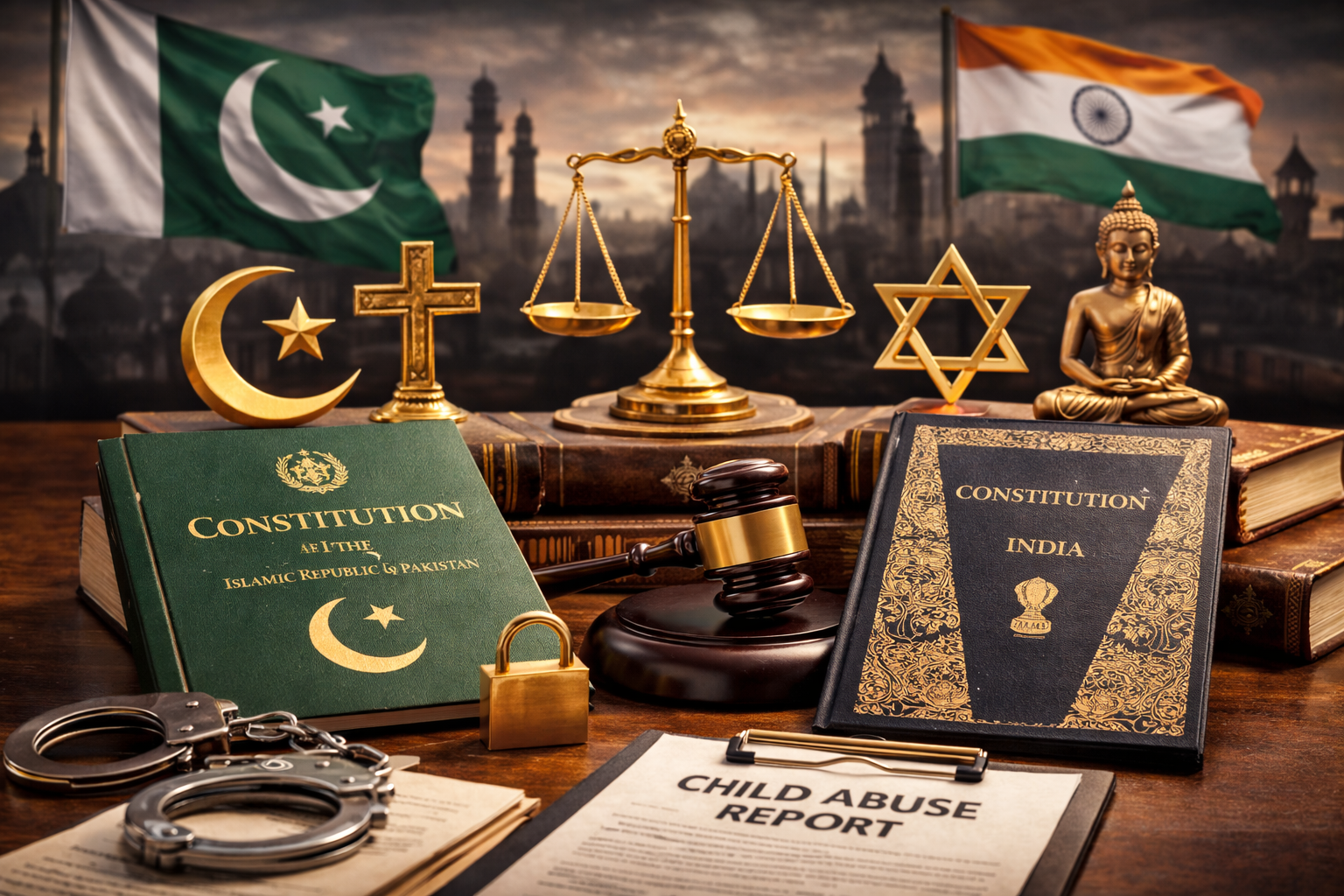
This article undertakes a comparative and analytical study of minority protection in Pakistan and India, focusing on how constitutional guarantees are translated into enforceable legal rights.
Abstract
This article undertakes a comparative and analytical study of minority protection in Pakistan and India, focusing on how constitutional guarantees are translated into enforceable legal rights. It examines the principal constitutional provisions that secure equality, religious freedom, and cultural autonomy, and evaluates the statutory and institutional mechanisms designed to safeguard minority communities. The article then analyses judicial interpretation in both jurisdictions to assess how courts have shaped the scope of minority rights and remedial protection. By comparing legal design with practical enforcement, it identifies recurring gaps,such as inconsistency in implementation, limited institutional powers, and challenges in securing effective remedies. The article concludes by proposing targeted reforms aimed at strengthening accountability, improving implementation, and enhancing the practical protection of minorities within each constitutional order.
1. Introduction
The protection of minorities is a persistent question of constitutional governance in South Asia. Pakistan and India were founded on commitments to equality and religious freedom, yet the effectiveness of minority protection remains under sustained legal and public scrutiny, particularly in light of judicial interventions, legislative developments, and recurring debates about state responses to minority-related grievances.
In the contemporary legal landscape, minority protection cannot be assessed by constitutional text alone. Its practical force depends on how guarantees are implemented through legislation, interpreted by courts, and delivered through institutions. Pakistan’s framework combines fundamental rights with an express constitutional commitment to safeguard minorities and mechanisms of political inclusion, while India’s constitutional design, shaped by secularism, places particular emphasis on cultural conservation and educational autonomy for religious and linguistic minorities.
Against this background, this article undertakes a comparative analysis of the constitutional and legal frameworks governing minority protection in Pakistan and India. It examines how constitutional promises are translated into enforceable protection through statutes, judicial interpretation, and institutional practice, and it identifies strengths, limitations, and reform directions within each system.
2. Research Methodology
This article adopts a comparative, doctrinal approach. It draws primarily on constitutional texts in Pakistan and India, key statutes relevant to minority protection, and leading judicial decisions interpreting minority rights. It also uses selected academic scholarship and policy commentary to evaluate how these legal frameworks function in practice, with particular attention to institutional design, enforcement, and remedies.
3. Legal Framework
3.1 Defining “minorities” for legal protection
In constitutional terms, a “minority” is a legal category that triggers protections aimed at securing equal citizenship and preserving group identity. These protections usually operate along two tracks: religious liberty and communal autonomy, and cultural or linguistic preservation, often through education. [1]
In Pakistan, minority protection is largely organized around religious identity within an Islamic constitutional framework. Islam is declared the State religion, and the Constitution expressly distinguishes between “Muslim” and “non-Muslim”, defining “non-Muslim” to include specified religious communities. [2] [3] Within that structure, the Constitution guarantees religious freedom, including the right to profess, practise, and propagate religion, and recognizes the autonomy of religious denominations to manage religious institutions, subject to law, public order, and morality. [4]
India’s Constitution protects minority identity primarily through cultural and educational guarantees. It secures the right of communities to conserve their language, script, and culture and grants minorities, whether based on religion or language, the right to establish and administer educational institutions of their choice. [5] Statutory mechanisms also use the category of “minority”, including where minority status is linked to communities notified by the Central Government for the purposes of the national minorities commission framework. [6] The Supreme Court has further treated the State as the relevant unit for determining minority status when the claim arises in relation to State legislation. [7]
These definitional choices matter because they determine who can access minority-specific institutions and claims, particularly in education, and they shape how grievances are framed, whether as individual liberty, group autonomy, or equality-based claims. [5]
3.2 Pakistan: constitutional protections and state duties
Pakistan’s Constitution couples general equality protections with religion-specific liberties and an express duty on the State to safeguard minorities. Equality before the law and equal protection are guaranteed, and the constitutional scheme also addresses non-discrimination and equal opportunity in public service. [8] [9]
Religious freedom is protected through the right to profess, practise, and propagate religion and through the autonomy of religious denominations to manage religious institutions, subject to law, public order, and morality. [4] The Constitution also protects conscience by prohibiting compelled financial support for the religious activities of a faith other than one’s own, and it contains safeguards in education against compelled religious instruction and discriminatory exclusion. [10] [11]
Pakistan further imposes a specific constitutional obligation on the State to safeguard the legitimate rights and interests of minorities, including due representation in federal and provincial services. [12] Political inclusion is supported through reserved seats for non-Muslims in the National Assembly and provincial assemblies, embedding minority participation within the constitutional structure. [13]
These protections operate within a constitutional identity that declares Islam the State religion and directs that laws be brought into conformity with Islamic injunctions, which shapes the interpretative environment and can create structural tensions in the balancing of rights and restrictions. [2] [14]
3.3 Pakistan: statutory protections and institutional architecture
Pakistan’s statutory approach affecting minorities is dispersed across criminal law, regulatory controls, and administrative governance. Criminal law is central, with offences relating to religion addressing conduct connected to places of worship, deliberate outraging of religious feelings, desecration of the Holy Qur’an, and derogatory remarks in respect of the Holy Prophet Muhammad (peace be upon him), alongside public-mischief provisions that address statements likely to promote enmity or ill-will between groups on grounds including religion. [15]
Regulation has also extended into the digital sphere. The Prevention of Electronic Crimes Act 2016 criminalizes online dissemination of material that advances or is likely to advance interfaith, sectarian, or racial hatred, reflecting a legislative attempt to address contemporary forms of hate speech. [16]
Administrative and property governance mechanisms also affect minorities, particularly in relation to religious endowments and the management of minority-linked properties. The Evacuee Trust Properties (Management and Disposal) Act 1975 establishes a federal framework for the supervision and control of evacuee trust property through the Evacuee Trust Property Board. [17]
Institutionally, minority-related concerns are addressed through a mix of specialized and general bodies. The National Commission for Human Rights is a statutory institution with an inquiry and recommendations mandate that can encompass minority-rights concerns where they arise as human rights issues. [18] Across these arrangements, a recurring issue is institutional strength. Many mechanisms operate through administration, coordination, or recommendations rather than direct enforcement, which can limit immediate remedial impact and make effectiveness dependent on executive follow-through. [18]
3.4 India: constitutional protections and minority-specific rights
India’s constitutional framework begins with general equality guarantees that apply to all persons and citizens. Equality before the law, non-discrimination on grounds including religion, and equality of opportunity in public employment provide the baseline for minority protection. [19]
Freedom of religion is secured through freedom of conscience and the right to profess, practise, and propagate religion, alongside denominational autonomy in matters of religion. These guarantees are complemented by provisions governing the relationship between religion and the State, including safeguards relating to religious taxation and religious instruction in educational institutions. [20]
Minority-specific rights are articulated most clearly through culture and education. The Constitution protects the right to conserve language, script, and culture, and it grants minorities the right to establish and administer educational institutions of their choice, together with a protection against discriminatory denial of State aid on that basis. [5]
Linguistic minorities are also supported through constitutional provisions directing mother-tongue instruction at the primary stage and through an institutional reporting mechanism under the Special Officer for Linguistic Minorities. [21]
Limits are built into the framework. Religious freedom is subject to public order, morality, and health, and it is also subject to other fundamental rights, with scope for State intervention in the interests of social welfare and reform. [22] The balance between secular constitutional commitments and minority autonomy has therefore been developed through constitutional reasoning that reconciles liberty, equality, and institutional autonomy within a plural constitutional order. [23]
3.5 India: statutory protections and institutional mechanisms
India’s statutory and institutional mechanisms operate alongside constitutional guarantees through specialized minority bodies and broader human-rights institutions. The National Commission for Minorities is constituted under the National Commission for Minorities Act 1992 and is tasked with monitoring safeguards and examining complaints, while operating primarily through inquiry and recommendations rather than direct coercive enforcement. [24] For the purposes of that framework, “minority” is tied to communities notified by the Central Government. [6]
A distinct statutory track exists for minority educational rights. The National Commission for Minority Educational Institutions Act 2004 establishes a specialized commission that supports minority educational institutions through an adjudicatory and facilitative mandate in matters such as status recognition and affiliation-related disputes. [25]
For minority-related grievances that also engage broader human-rights protections, complainants may also pursue remedies through human-rights commissions under the Protection of Human Rights Act 1993, which provides inquiry and recommendation powers. [26] In practice, the accessibility of these mechanisms may be affected by overlapping jurisdictions, variable institutional responsiveness, and procedural complexity, which can dilute the practical value of formal safeguards. [24]
3.6 Comparative synthesis for the Legal Framework
Pakistan and India adopt distinct constitutional strategies. Pakistan combines general fundamental rights with an explicit duty to safeguard minorities and with reserved representation, embedding minority participation within the constitutional structure. [12] [13] India, by contrast, places greater emphasis on group-based protection through culture and education, supported by a developed jurisprudence on minority educational autonomy and the permissible limits of State regulation. [5] [7]
This comparison frames the evaluative question that drives the article: which framework is more capable of producing enforceable protection in practice, and why. The answer depends not only on constitutional text, but also on institutional pathways, remedial design, and implementation consistency.
The comparison also explains why courts become central to defining the real scope of minority protection in both jurisdictions. Where constitutional provisions are broad and statutory bodies operate mainly through monitoring and recommendations, judicial interpretation supplies the operative standards for balancing rights against restrictions and for shaping workable remedies. [27] [28]
4. Judicial Interpretation
4.1 Pakistan: constitutional adjudication and minority protection
Pakistan’s Supreme Court has treated minority protection as a question of constitutional governance where implementation failures risk emptying constitutional guarantees of practical content. [29] In Suo Motu Case No 1 of 2014, the Court framed minority protection as an affirmative constitutional responsibility grounded in religious freedom, equality, and the Constitution’s express commitment to safeguarding minorities. [29] [30]
The judgment is significant for its remedial posture. Rather than stopping at declarations, the Court issued structural directions aimed at institutional delivery, including measures linked to protection of places of worship, curbing hate speech, institutional coordination on minority rights, and follow-up oversight to secure implementation. [29] The case illustrates a positive-duty approach in which constitutional rights justify requiring the State to act through policing and administrative safeguards, not merely to refrain from interference. [29] [30]
A persistent limitation, however, is the implementation gap. Structural orders depend on executive compliance and capacity, so judicial intervention may be strong in principle but uneven in delivery. [29]
4.2 India: minority rights jurisprudence, especially education and autonomy
In India, minority protection has been shaped most decisively through constitutional adjudication on minority educational rights under Article 30. [31] The core logic is that minorities must retain meaningful autonomy to establish and administer institutions that preserve identity, while remaining subject to regulation that serves legitimate public purposes and does not destroy the essence of the right. [31].
T.M.A. Pai Foundation established the foundational framework. It clarified that minority status for Article 30 purposes is ordinarily assessed with reference to the relevant State, and it distinguished permissible regulation from impermissible control, emphasising that administrative autonomy is not a licence for maladministration. [31] Islamic Academy of Education and P.A. Inamdar then refined the autonomy-regulation boundary in the context of admissions and fees in private unaided professional institutions, seeking to reconcile autonomy with standards, fairness, and the prevention of profiteering, while limiting the scope of direct state control in the unaided sector. [32] [33]
4.3 Comparative evaluation of judicial roles
Judicial emphases mirror constitutional design. In Pakistan, courts more readily frame minority protection as a State duty and respond with implementation-oriented directions when minority insecurity is presented as a governance failure. [29] In India, courts have most visibly shaped minority protection through doctrinal refinement of autonomy and regulation, especially in education, using balancing frameworks that determine the practical content of minority rights. [31] [33]
In both systems, judicial protection is not self-executing. Pakistan’s structural remedies depend on follow-through and capacity, while India’s doctrinal clarity can still be diluted where regulation expands or implementation is uneven. [29] [33] This leads into the critical analysis that follows: persistent gaps are best explained through enforcement design, institutional capacity, and implementation dynamics, rather than constitutional text alone. [29] [31]
5. Critical Analysis
5.1 The enforcement gap: rights on paper versus protection in practice
A recurring problem in both jurisdictions is the distance between constitutional promise and institutional delivery. Formal rights may be clear in text, but practical protection depends on bodies that can investigate, coordinate, and ensure follow-through, and on remedies that can be implemented on the ground.
Access to justice constraints deepen this gap. Minority-rights claims can involve urgent protection needs, yet litigation and complaint pathways may be slow, costly, and procedurally complex. Delays, limited legal awareness, and fear of retaliation can discourage reporting and reduce the likelihood that available remedies will be pursued to completion.
The quality of remedies also matters. Even where courts articulate strong constitutional standards, protection may remain fragile if orders are not monitored, if compliance is inconsistent, or if implementation requires resources and coordination that are not reliably available.
5.2 Pakistan: core challenges and doctrinal tensions
Pakistan’s minority-rights jurisprudence includes ambitious structural directions, but their practical effect often turns on compliance, coordination, and sustained oversight by executive agencies and law-enforcement bodies. [34]
A second challenge arises from the sensitivity of criminal-law provisions connected to religion. Where such provisions are misused, or where procedural safeguards are weak in practice, minority communities may face heightened vulnerability despite formal constitutional guarantees. [35]
Protective mechanisms in education, policing, and worship-place security illustrate the same delivery problem. Constitutional safeguards and the State’s duty to safeguard minorities can support strong protection in principle, but day-to-day effectiveness depends on consistent administrative practice and credible law-enforcement response. [36]
5.3 India: core challenges and doctrinal tensions
India’s minority-rights jurisprudence is most developed in education, but maintaining the boundary between permissible regulation and effective control remains difficult in practice. Regulatory expansion can narrow the space within which minority institutions exercise genuine autonomy in administration and governance, and state-level variation can produce uneven protection and uneven access to remedies. [37]
5.4 Comparative critique using standards of effectiveness
On an effectiveness standard, the two systems display different strengths and vulnerabilities. Pakistan’s framework combines general rights with an express duty to safeguard minorities and with representation mechanisms, supporting a strong constitutional narrative of inclusion, but the impact of judicially articulated duties can be undermined by compliance deficits and capacity constraints. [34]
India’s framework offers stronger doctrinal development of group-based autonomy, particularly in education, and relatively detailed judicial guidance on regulatory limits, yet practical protection can still be diluted where regulation expands or implementation differs across States. [37]
This comparative assessment leads into recent developments. Reforms and policy debates in both jurisdictions increasingly focus on institutional strengthening, clearer enforcement pathways, and mechanisms that make remedies more timely and practically meaningful.
6. Recent Developments
6.1 Pakistan: legislative and institutional developments
A major institutional development is the enactment of legislation establishing a National Commission for Minorities’ Rights. The President assented to the National Commission for Minorities Rights Bill 2025 after it was passed in a joint session of Parliament, and the reported amendments included the removal of an overriding-effect clause and the withdrawal of proposed suo motu powers, indicating sensitivity to constitutional and political concerns about the commission’s reach. [38]
In terms of mandate, the commission is intended to strengthen monitoring of constitutional safeguards and to provide an institutional route for minority-related grievances. Public reporting suggests that the proposed model combines oversight, inspection, and recommendation functions, including engagement with implementation of court directions, but that its practical impact will depend on independence, resources, and follow-through by executive agencies. [39]
Recent policy discussion has also focused on institutions connected to minority worship sites and heritage. In 2025, government statements indicated plans for structural reforms in the Evacuee Trust Property Board, including measures aimed at digitisation and improved performance, while the Board’s 2024 to 2025 performance reporting highlighted substantial allocations for maintenance and development of minority religious sites and projected further allocations for 2025 to 2026. [40] [41]
At the same time, debate on effectiveness continues. Commentary and legal reporting frequently return to the persistent implementation gap in relation to the Supreme Court’s 2014 minority-rights directions, treating compliance as uneven and stressing the need for institutional mechanisms that translate constitutional commitments into consistent protection on the ground. [42]
6.2 India: evolving policy environment affecting minority protections
In India, recent developments have largely arisen through litigation and policy contestation in the education sector, where minority autonomy frequently intersects with equality-based regulation. In September 2025, reporting indicated that the Supreme Court expressed serious doubt about its earlier decision exempting minority educational institutions from the Right to Education Act, and referred the issue for consideration by a larger bench, signalling renewed judicial attention to the balance between Article 21A and Article 30. [43]
At the state and regulatory level, minority institutions have also challenged measures perceived as intruding into institutional autonomy. In January 2026, the Delhi High Court sought responses on petitions by minority schools challenging the constitutional validity of a school-fee regulation law, with the petitions asserting that certain provisions violate constitutional protections enjoyed by minority institutions. [44]
State-level legislative movement adds further complexity. In August 2025, Uttarakhand’s cabinet approved the Uttarakhand Minority Educational Institutions Bill 2025, intended to extend minority-status benefits beyond madrassa-focused regulation and to create a dedicated authority to oversee minority educational institutions in the state. [45]
Judicial clarification has also continued at the national level. A Constitution Bench reference judgment delivered in November 2024 examined the National Commission for Minority Educational Institutions Act 2004 and its 2010 amendments, including the statutory shift from “established or maintained” to “established and administered”, and addressed how such statutory language interacts with the constitutional interpretation of Article 30. [46]
6.3 Why recent developments matter?
These developments matter because they test whether legal change strengthens protection in practice or remains largely symbolic. In Pakistan, the creation of a specialised commission could improve oversight and complaint-handling, but its effectiveness will depend on clear powers, credible independence, and administrative follow-through.
In India, the continuing cycle of litigation and state-level policy initiatives shows that minority protection is dynamic and contested, particularly in education. The trajectory reinforces the article’s central point: constitutional protection is shaped not only by rights text, but by institutional design, regulatory practice, and the ability of courts and public bodies to deliver timely and meaningful remedies.
7. Reforms and the Road Ahead
7.1 Reform objectives
Reform in both jurisdictions should be assessed against three connected objectives: closing the enforcement gap, strengthening remedies and accountability, and preserving constitutional legitimacy in plural societies. The enforcement gap is visible where constitutional guarantees are affirmed judicially but remain uneven in delivery, particularly when implementation depends on executive follow-through and institutional capacity. [47]
7.2 Pakistan: priority reform directions
Pakistan’s most immediate reform priority is institutional strengthening. The enactment of legislation establishing a National Commission for Minorities’ Rights signals movement towards a specialised oversight body, but its effectiveness will depend on independence, resources, and a clear mandate that allows credible complaint-handling and follow-through with relevant authorities. [48] A second priority is implementation reform. Structural directions can only protect minorities if there is a concrete compliance framework, including time-bound reporting, measurable indicators, and an institutional focal point responsible for monitoring implementation of court directions and documenting action taken. [47] Finally, legal safeguards should be strengthened to reduce vulnerability from misuse of religion-related offences. This requires robust procedural checks, prompt and impartial investigation protocols, and safeguards against abuse, while maintaining public order protections. [49] The same logic applies to online hate speech enforcement, where consistent application and transparent standards are essential to avoid selective enforcement while protecting vulnerable communities. [50]
7.3 India: priority reform directions
In India, reform priorities are closely tied to the education sector and the autonomy-regulation boundary. Judicial doctrine already offers structured guidance on minority educational autonomy and permissible regulation, but stronger administrative clarity is needed so that regulation does not become effective control in practice. [51] [52] This can be advanced through transparent regulatory standards, consistent decision-making on minority status, and clearer procedural safeguards in disputes involving affiliation, recognition, and fee and admissions regulation, areas where the specialised commission under the 2004 Act can play a more effective role if supported with capacity and clear coordination with state authorities. [53] [54] A broader priority is strengthening anti-discrimination and accountability mechanisms, including consistent enforcement across states and improved complaint-handling capacity in institutions that address minority-related human-rights violations. [55]
7.4 Comparative reform lessons
Comparative learning is available without importing foreign models. Pakistan can draw from India’s structured minority-rights jurisprudence, especially the developed analysis of how autonomy is preserved while allowing reasonable regulation, which can help build clearer standards for minority institutions and reduce discretionary inconsistency. [51] India, in turn, can draw from Pakistan’s constitutional emphasis on an express state duty to safeguard minorities and on representation mechanisms, which underline that minority protection is also a question of participation and institutional voice. [56] Across both systems, best practice principles converge: independent oversight with credible powers, measurable implementation plans, timely and effective remedies, and reforms that strengthen protection without diluting constitutional commitments. [47]
7.5 Future trajectory and concluding bridge
The likely trajectory in both jurisdictions is continued reliance on courts to clarify the scope of minority rights, alongside gradual institutional reform aimed at improving implementation. The central thesis is reinforced by recent experience: constitutional promise matters, but the decisive variable is institutional delivery. The next section therefore translates the above reform directions into targeted, constructive recommendations for the judiciary, legislature, executive institutions, and civil society.
8. Conclusion
This article has compared the constitutional and legal frameworks for minority protection in Pakistan and India, and has shown that both systems combine broad rights guarantees with distinct structural choices. Pakistan’s framework is marked by an express constitutional duty to safeguard minorities and by reserved political representation, while India’s framework places greater weight on cultural and educational autonomy, supported by an extensive body of constitutional jurisprudence. Across both jurisdictions, however, the central challenge is not the absence of legal promises, but the uneven translation of those promises into reliable protection through institutions, enforcement, and remedies.
The importance of minority protection lies in what it signals about constitutional legitimacy in plural societies. Where minorities cannot access timely remedies, or where safeguards depend on discretionary or inconsistent implementation, equality and religious freedom risk becoming formal assurances rather than lived rights. Recent reforms and ongoing debates therefore matter most when they strengthen accountability, clarify institutional roles, and make protection practically available.
The comparative lesson is clear. Constitutional text and judicial reasoning can set the standard, but durable protection depends on institutional delivery. The question for both Pakistan and India is therefore not whether minority rights are recognized in principle, but whether their legal systems can ensure that those rights are enforceable, predictable, and meaningful in everyday life.
Bibliography/References (OSCOLA)
[1] Constitution of India 1950, arts 29 and 30 https://www.indiacode.nic.in/bitstream/123456789/19151/1/constitution_of_india.pdf
[2] Constitution of the Islamic Republic of Pakistan 1973, art 2 https://na.gov.pk/uploads/documents/6926e060076ed_467.pdf
[3] Constitution of the Islamic Republic of Pakistan 1973, art 260(3)(b) https://na.gov.pk/uploads/documents/6926e060076ed_467.pdf
[4] Constitution of the Islamic Republic of Pakistan 1973, art 20 https://na.gov.pk/uploads/documents/6926e060076ed_467.pdf
[5] Constitution of India 1950, art 29(1) and art 30(1) and (2) https://www.indiacode.nic.in/bitstream/123456789/19151/1/constitution_of_india.pdf
[6] National Commission for Minorities Act 1992, s 2(c) https://upload.indiacode.nic.in/view-casepdf?id=AC_CEN_41_69_00001_199219_1517807322944&type=act
[7] T.M.A. Pai Foundation v State of Karnataka (2002) 8 SCC 481 https://indiankanoon.org/doc/665015/
[8] Constitution of the Islamic Republic of Pakistan 1973, art 25 https://na.gov.pk/uploads/documents/6926e060076ed_467.pdf
[9] Constitution of the Islamic Republic of Pakistan 1973, art 27 https://na.gov.pk/uploads/documents/6926e060076ed_467.pdf
[10] Constitution of the Islamic Republic of Pakistan 1973, art 21 https://na.gov.pk/uploads/documents/6926e060076ed_467.pdf
[11] Constitution of the Islamic Republic of Pakistan 1973, art 22 https://na.gov.pk/uploads/documents/6926e060076ed_467.pdf
[12] Constitution of the Islamic Republic of Pakistan 1973, art 36 https://na.gov.pk/uploads/documents/6926e060076ed_467.pdf
[13] Constitution of the Islamic Republic of Pakistan 1973, arts 51(4) and 106(1) https://na.gov.pk/uploads/documents/6926e060076ed_467.pdf
[14] Constitution of the Islamic Republic of Pakistan 1973, art 227(1) https://na.gov.pk/uploads/documents/6926e060076ed_467.pdf
[15] Pakistan Penal Code 1860, ss 295, 295A, 295B, 295C and 505(2) https://pakistancode.gov.pk/english/UY2FqaJw1-apaUY2Fqa-apaUY2Npa5lo-sg-jjjjjjjjjjjjj
[16] Prevention of Electronic Crimes Act 2016, s 11 https://pakistancode.gov.pk/english/UY2FqaJw1-apaUY2Fqa-apaUY2Jvbp8%253D-sg-jjjjjjjjjjjjj
[17] Evacuee Trust Properties (Management and Disposal) Act 1975, ss 3 and 4 https://pakistancode.gov.pk/english/UY2FqaJw1-apaUY2Fqa-bpuUZWNp-sg-jjjjjjjjjjjjj
[18] National Commission for Human Rights Act 2012 https://pakistancode.gov.pk/english/UY2FqaJw1-apaUY2Fqa-apaUY2Npa5lrbA%3D%3D-sg-jjjjjjjjjjjjj
[19] Constitution of India 1950, arts 14, 15 and 16 https://www.indiacode.nic.in/bitstream/123456789/19151/1/constitution_of_india.pdf
[20] Constitution of India 1950, arts 25, 26, 27 and 28 https://www.indiacode.nic.in/bitstream/123456789/19151/1/constitution_of_india.pdf
[21] Constitution of India 1950, arts 350A and 350B https://www.indiacode.nic.in/bitstream/123456789/19151/1/constitution_of_india.pdf
[22] Constitution of India 1950, art 25(1) and (2) https://www.indiacode.nic.in/bitstream/123456789/19151/1/constitution_of_india.pdf
[23] S R Bommai v Union of India (1994) 3 SCC 1 https://indiankanoon.org/doc/60799/
[24] National Commission for Minorities Act 1992, s 9 https://upload.indiacode.nic.in/view-casepdf?id=AC_CEN_41_69_00001_199219_1517807322944&type=act
[25] National Commission for Minority Educational Institutions Act 2004 https://www.indiacode.nic.in/bitstream/123456789/1897/1/A2005-2.pdf
[26] Protection of Human Rights Act 1993, ss 12 and 18 https://www.indiacode.nic.in/bitstream/123456789/13233/1/the_protection_of_human_rights_act_1993.pdf
[27] Suo Motu Case No 1 of 2014 (2014) PLD SC 699 https://globalfreedomofexpression.columbia.edu/wp-content/uploads/2015/04/smc_1_2014.pdf
[28] P.A. Inamdar v State of Maharashtra (2005) 6 SCC 537 https://indiankanoon.org/doc/1390531/
[29] Suo Motu Case No 1 of 2014 (2014) PLD SC 699 [37] https://globalfreedomofexpression.columbia.edu/wp-content/uploads/2015/04/smc_1_2014.pdf
[30] Constitution of the Islamic Republic of Pakistan 1973, arts 20, 25 and 36 https://na.gov.pk/uploads/documents/6926e060076ed_467.pdf
[31] T.M.A. Pai Foundation v State of Karnataka (2002) 8 SCC 481 https://indiankanoon.org/doc/665015/
[32] Islamic Academy of Education v State of Karnataka (2003) 6 SCC 697 https://indiankanoon.org/doc/1978528/
[33] P.A. Inamdar v State of Maharashtra (2005) 6 SCC 537 https://indiankanoon.org/doc/1390531/
[34] Suo Motu Case No 1 of 2014 (2014) PLD SC 699 [37] https://globalfreedomofexpression.columbia.edu/wp-content/uploads/2015/04/smc_1_2014.pdf
[35] Pakistan Penal Code 1860, ss 295, 295A, 295B and 295C https://pakistancode.gov.pk/english/UY2FqaJw1-apaUY2Fqa-apaUY2Npa5lo-sg-jjjjjjjjjjjjj
[36] Constitution of the Islamic Republic of Pakistan 1973, arts 22 and 36 https://na.gov.pk/uploads/documents/6926e060076ed_467.pdf
[37] T.M.A. Pai Foundation v State of Karnataka (2002) 8 SCC 481 https://indiankanoon.org/doc/665015/; Islamic Academy of Education v State of Karnataka (2003) 6 SCC 697 https://indiankanoon.org/doc/1978528/ ; P.A. Inamdar v State of Maharashtra (2005) 6 SCC 537 https://indiankanoon.org/doc/1390531/
[38] Staff Reporter, ‘President assents to bill for setting up minorities’ commission’ Dawn (Karachi, 17 December 2025) https://www.dawn.com/news/1961642
[39] Waqas Chaudhry, ‘Parliament clears bill to establish commission for minority rights’ The Express Tribune (2 December 2025) https://tribune.com.pk/story/2580150/na-passes-national-commission-for-minority-rights-bill-2025-amid-opposition-uproar
[40] Khalid Hasnain, ‘Structural reforms to be introduced in ETPB’ Dawn (Karachi, 4 August 2025) https://www.dawn.com/news/1928574
[41] Associated Press of Pakistan, ‘ETPB releases annual performance report, highlights financial, administrative gains’ (12 July 2025) https://www.app.com.pk/domestic/etpb-releases-annual-performance-report-highlights-financial-administrative-gains/
[42] Shafique Chaudhry, ‘Delayed justice for minorities’ Pakistan Observer (26 December 2025) https://pakobserver.net/delayed-justice-for-minorities/
[43] Amit Anand Choudhary, ‘Why are minority institutions left out of RTE, asks SC’ The Times of India (2 September 2025) https://timesofindia.indiatimes.com/india/why-are-minority-institutions-left-out-of-rte-asks-sc/articleshow/123643958.cms
[44] TNN, ‘HC seeks reply on pleas challenging fee hike law’ The Times of India (Delhi, 10 January 2026) https://timesofindia.indiatimes.com/city/delhi/hc-seeks-reply-on-pleas-challenging-fee-hike-law/articleshow/126442643.cms
[45] Kautilya Singh, ‘Uttarakhand to repeal madrassa Act, new law to cover all minority institutions’ The Times of India (18 August 2025) https://timesofindia.indiatimes.com/india/uttarakhand-to-repeal-madrassa-act-new-law-to-cover-all-minority-institutions/articleshow/123351540.cms
[46] 2024 INSC 856, paras 70, 155–157 (Supreme Court of India, 8 November 2024) https://api.sci.gov.in/supremecourt/2006/9287/9287_2006_1_1501_57054_Judgement_08-Nov-2024.pdf
[47] Suo Motu Case No 1 of 2014 (2014) PLD SC 699 [37] https://globalfreedomofexpression.columbia.edu/wp-content/uploads/2015/04/smc_1_2014.pdf
[48] Staff Reporter, ‘President assents to bill for setting up minorities’ commission’ Dawn (Karachi, 17 December 2025) https://www.dawn.com/news/1961642
[49] Pakistan Penal Code 1860, ss 295, 295A, 295B and 295C https://pakistancode.gov.pk/english/UY2FqaJw1-apaUY2Fqa-apaUY2Npa5lo-sg-jjjjjjjjjjjjj
[50] Prevention of Electronic Crimes Act 2016, s 11 https://pakistancode.gov.pk/english/UY2FqaJw1-apaUY2Fqa-apaUY2Jvbp8%253D-sg-jjjjjjjjjjjjj
[51] T.M.A. Pai Foundation v State of Karnataka (2002) 8 SCC 481 https://indiankanoon.org/doc/665015/
[52] P.A. Inamdar v State of Maharashtra (2005) 6 SCC 537 https://indiankanoon.org/doc/1390531/
[53] Constitution of India 1950, art 30(1) and (2) https://www.indiacode.nic.in/bitstream/123456789/19151/1/constitution_of_india.pdf
[54] National Commission for Minority Educational Institutions Act 2004 https://www.indiacode.nic.in/bitstream/123456789/1897/1/A2005-2.pdf
[55] Protection of Human Rights Act 1993, ss 12 and 18 https://www.indiacode.nic.in/bitstream/123456789/13233/1/the_protection_of_human_rights_act_1993.pdf
[56] Constitution of the Islamic Republic of Pakistan 1973, arts 36, 51(4) and 106(1) https://na.gov.pk/uploads/documents/6926e060076ed_467.pdf